
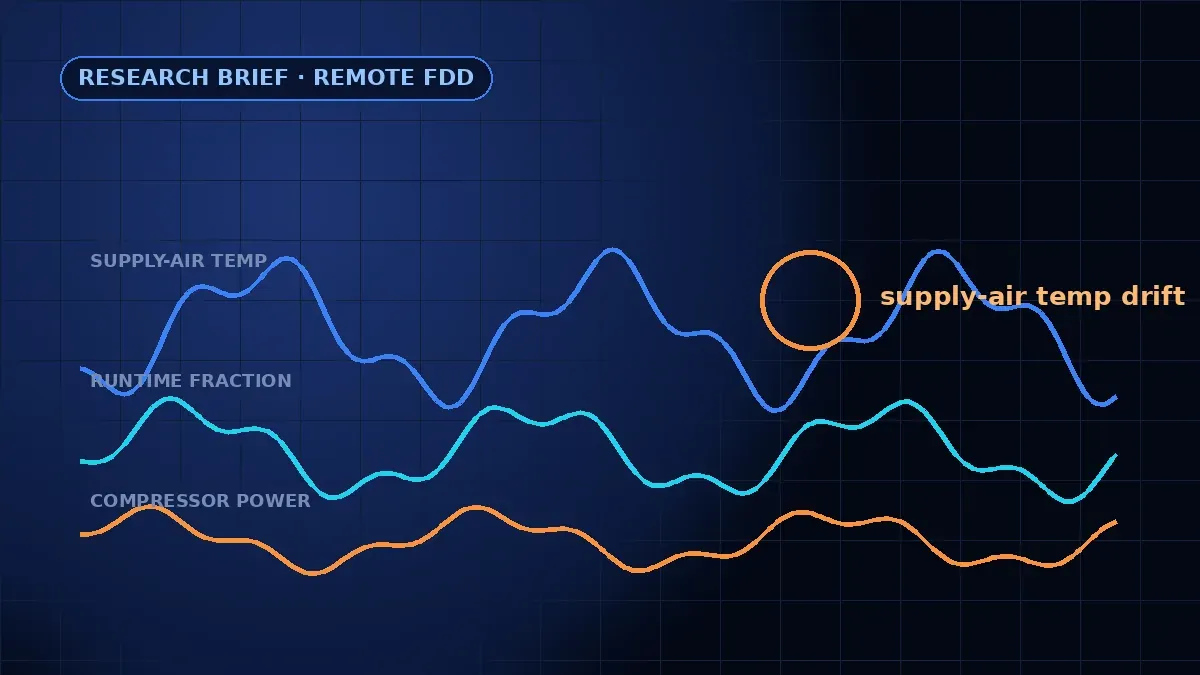
Millions of homes already have connected thermostats sending data to the cloud. Could that same data flag a refrigerant problem before the homeowner notices? Oak Ridge National Laboratory (ORNL) set out to test it. The results were published in October 2024 in Residential HVAC Fault Detection: Field Data Analysis and Interviews with Smart Thermostat Manufacturers.
How the test worked
The team used ORNL's Yarnell Station research house in Knoxville, Tennessee: a 2,400 sq ft home with a 3-ton single-stage heat pump installed in 2009. From May to September 2024 they deliberately changed the refrigerant charge:
- Undercharge from −10% down to −50%
- Overcharge from +5% up to +25%
Throughout the tests they logged weather, indoor temperature and humidity, supply and return air temperatures, airflow and component-level energy use at 1-minute and 1-hour intervals.
What showed up in the data
- At 40% and 50% undercharge, the house had unmet hours: the system could no longer hold the thermostat setpoint.
- At the deepest undercharge, supply-air temperature rose by about 5°F (roughly 3°C).
- When undercharged, the compressor drew less energy per minute but ran longer.
- When overcharged, indoor temperature stayed on setpoint and supply-air temperature and runtime barely changed. Compressor energy per minute increased with the amount of overcharge.
The limits
The report is careful about what remote data can and cannot do. It states that low-intensity refrigerant undercharge is “difficult to detect using only indoor air temperature data”, which is mostly what a thermostat sees. The researchers identified supply-air temperature, system runtime fraction and compressor energy as the more promising variables for remote detection, and noted that heating-season testing is still needed before detection rules can be finalized.
Interviews with thermostat manufacturers raised practical barriers too: the cost of integrating extra sensors and compatibility across many equipment brands.
What this means for technicians
A thermostat on its own mostly knows indoor temperature and when the system is running. Remote fault detection becomes useful when a few more signals are added, such as supply-air temperature and power draw, and when readings are compared against that system's own history. Even then, remote data can only point to a likely cause. Charge still has to be verified with gauges using the manufacturer's method.
The Diagvance view
This is why our system focuses on capturing a small set of inexpensive measurements alongside fault codes, then turning them into a ranked list of likely causes for the technician. It is a starting point for the call, not a final diagnosis.