
A heat pump or air conditioner can carry a high efficiency rating on the nameplate and still waste energy for years, simply because of how it was installed. Two studies, published more than a decade apart, put real numbers on that gap.
What the 2026 field study found
Researchers from Pacific Northwest National Laboratory (PNNL), the University of Central Florida and Proctor Engineering Group inspected 83 recently installed residential systems in Arizona, California and Florida. They then reproduced the most common faults on two identical heat pumps at the Florida Solar Energy Center's test facility. The results were presented at ACEEE in 2026.
- Only 55% of standard-practice systems had the correct refrigerant charge, compared with 92% of systems installed through quality-installation programs.
- 53% of systems ran below 350 CFM per ton of evaporator airflow.
- 76% were oversized beyond the manufacturer's recommendation.
- Average total duct leakage was 21%, with 14% leaking to the outside.
The authors' conclusion is blunt: installation faults are “commonplace, even among a sample of systems mostly permitted.”
What those faults cost
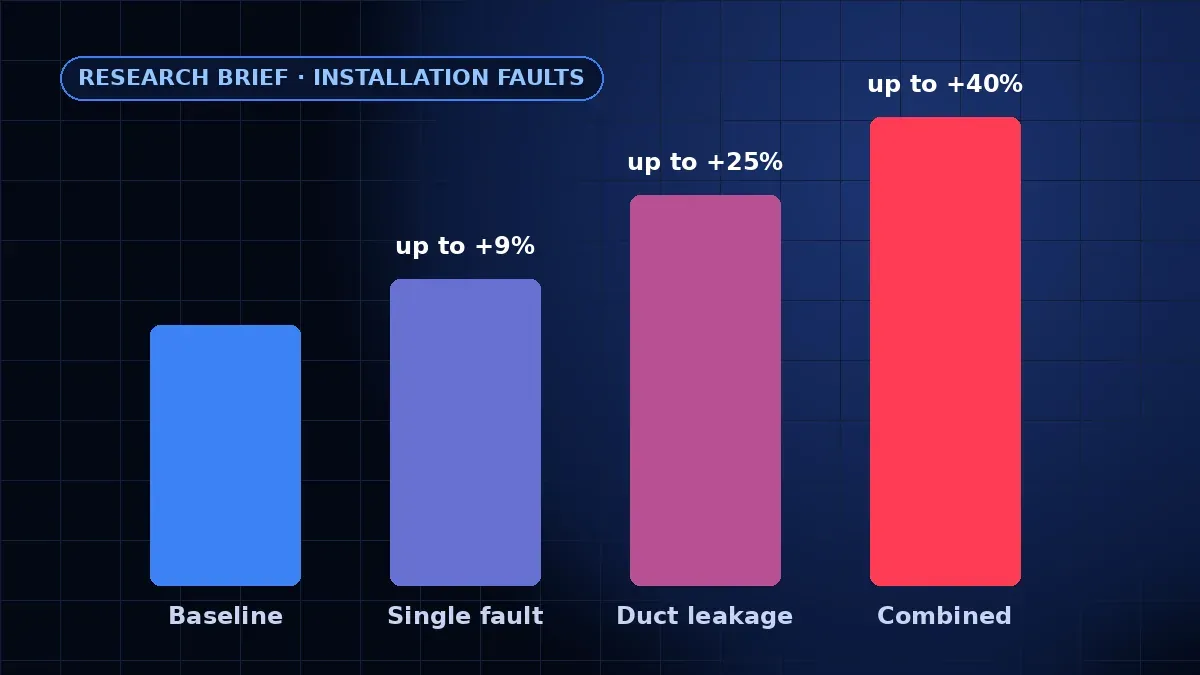
In the lab, a single fault on its own raised cooling energy by roughly 4–9%. Duct leakage alone had a seasonal impact of 17–25%. When faults were stacked together (a 30% refrigerant undercharge, leaky ducts and non-condensables in the system), cooling energy rose by 38–40%.
These numbers line up with earlier work from NIST. In Technical Note 1848 (2014), Piotr Domanski, Hugh Henderson and Vance Payne modelled seven common installation faults and estimated that improper installation can increase heating and cooling energy use “on the order of 30 percent”. They also found that most faults add up when they occur together.
Why this matters on a service call
Most of these faults do not trigger an error code. A system that is 20% undercharged and short on airflow will usually still heat or cool the house. It just runs longer, costs more and wears out sooner. Homeowners call when comfort drops, not when efficiency drops.
That is why the basics still decide the outcome of a call: verifying charge against the manufacturer's method, measuring airflow and static pressure, and checking duct leakage. It also explains why it helps to know how a system behaved before the technician arrived.
The Diagvance view
Diagvance is building tools that help a technician start each call with an organized picture: fault codes, manufacturer guidance and logged readings, ranked by likelihood. This research is a useful reminder that the most common problems are ordinary installation and maintenance faults, not rare component failures. Any suggestion our software makes still has to be confirmed with gauges and meters on site.
Sources
- Martin, Withers, Fenaughty, Panchabikesan, Downey, Conant: Finding Fault, ACEEE paper on the prevalence and energy impacts of residential HVAC installation faults (2026)
- NIST: Underperforming? Energy Efficiency of HVAC Equipment Suffers Due to Poor Installation (2014)
- Domanski, Henderson, Payne: Sensitivity Analysis of Installation Faults on Heat Pump Performance, NIST TN 1848