
Lab ratings tell you what a heat pump can do. Remote monitoring in occupied homes shows what it actually does through a real winter, and the two are not always the same.
Minute-by-minute data from real homes
In a report published by the U.S. National Renewable Energy Laboratory (NREL), James Williamson and Robb Aldrich of the Consortium for Advanced Residential Buildings monitored seven ductless, inverter-driven heat pumps in homes in Vermont, Connecticut and Massachusetts from November 2013 to April 2014. Power use, supply, return and outdoor air temperatures, and airflow were logged remotely every minute.
What the data showed
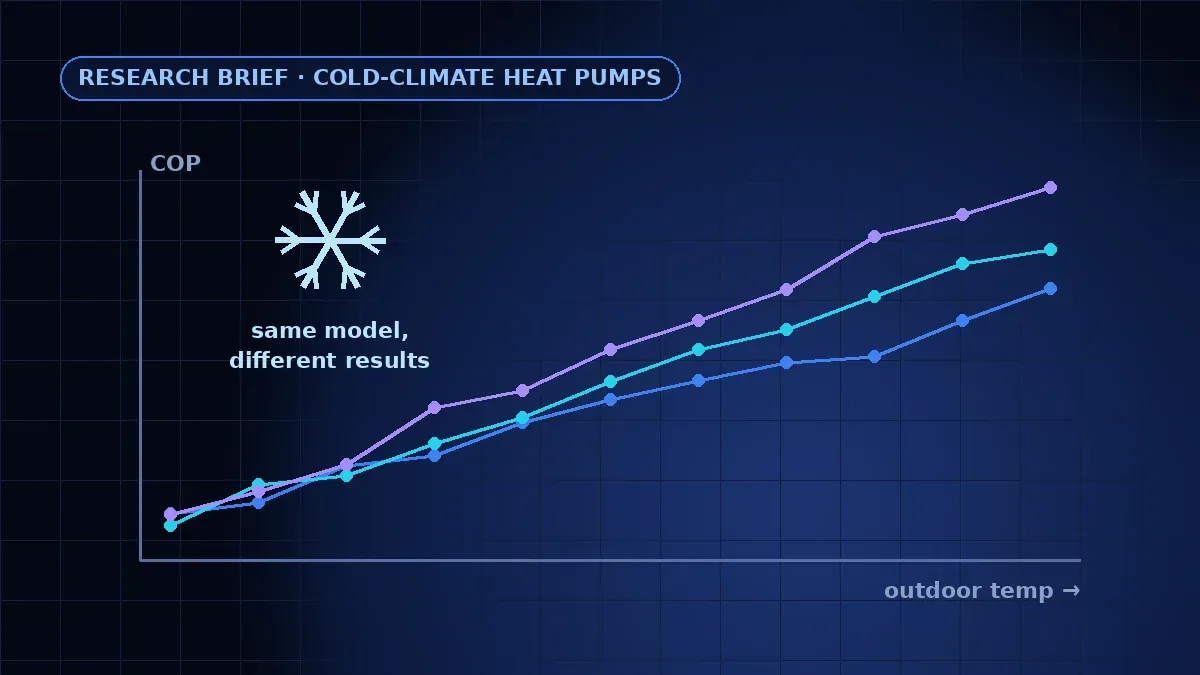
- Seasonal efficiency (COP) ranged from 1.1 to 2.3 across sites.
- Cold-weather capacity was real: one unit delivered about 15,000 Btu/h at −15°F (−26°C).
- Measured indoor airflow was typically only 50–80% of the manufacturer's listed rates.
- High return-air temperatures (averages above 75°F, about 24°C) noticeably lowered efficiency.
- Occupant choices such as manual low-fan settings and thermostat setbacks reduced performance.
- Defrost cycles, though frequent at some sites, had little effect on overall efficiency.
The authors' key finding: performance varied dramatically even between identical models, driven mainly by installation choices, occupant controls and the building, not by the limits of the equipment.
Closer to home: British Columbia
RDH Building Science ran a similar study in BC, monitoring 26 ductless and central heat pump systems in 24 homes on Vancouver Island and in the BC interior from April 2019 to April 2020. The goal was to understand how cold-climate heat pumps perform in Canadian conditions and to identify the design and installation practices that improve real-world results.
Lessons for technicians
- When a customer says the heat pump “can't keep up in the cold”, check airflow, fan settings and filter condition before assuming a refrigerant or equipment problem.
- Look at where the indoor head is mounted. Warm air collecting near the ceiling raises return-air temperature and lowers efficiency.
- Walk homeowners through the controls. Deep setbacks and fixed low-fan modes can work against an inverter system.
- Without data, all of these problems look the same to the customer: “it doesn't heat.”
The Diagvance view
Remote monitoring turns a vague complaint into evidence. Diagvance is building toward low-cost sensing that records temperatures and runtime, so a technician can see how a system behaved before arriving and walk in with a short list of likely causes. Those causes are confirmed on site, as always.